
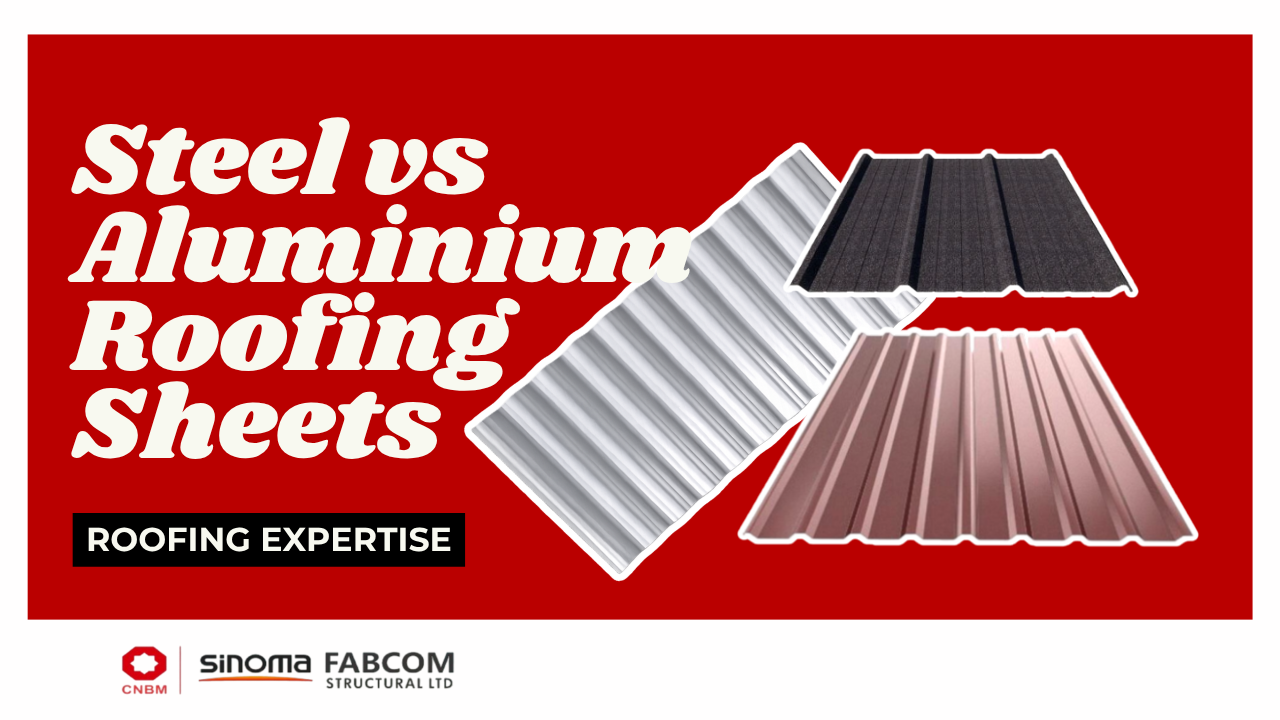
You are probably going to hear several different opinions when you start comparing roofing sheets for a building in Nigeria.
An installer may recommend aluminium because it does not rust. Another person may tell you steel is stronger and will hold its shape better. Someone else may focus on the price per sheet. If you are building a house, school, church, warehouse or commercial property, these opinions can make the buying decision harder because each person may be talking about a different part of the problem.
The important thing is to look beyond the initial purchase and consider how the roofing material is expected to perform on the actual building.
- What people are truly worried about when choosing roofing sheets
- Why the Steel and Aluminium Roofing Sheets Decision Matters Before You Buy
- What Is the Difference Between Aluminium and Coloured Steel Roofing?
- What Buyers Are Usually Trying to Avoid
- Steel and Aluminium Roofing Sheets Differences
- Strength and Rigidity Matter More as the Roof Gets Larger
- What Happens on a Building Site?
- Does Aluminium Roofing Rust?
- Can Coloured Steel Roofing Corrode?
- Which Is Better for Coastal Areas?
- Which Is Better for Inland Buildings?
- What About Rainfall Noise?
- What About Heat Under the Sunlight?
- Does Steel Roofing Maintain Its Shape Better Than Aluminium?
- How Long Do Steel and Aluminium Roofing Sheets Last?
- Which Roofing Material Requires Less Maintenance?
- Which Is Cheaper?
- How to Compare Two Roofing Quotations
- What Type of Building Is Each Material Suitable For?
- Why Long Span Roofing Matters
- Why the Profile Matters
- What About Installation Quality?
- What Should You Ask Before Choosing Steel or Aluminium Roofing?
- Why We Use Long Span Roofing
- FAQ: Steel vs Aluminium Roofing Sheets in Nigeria
- Choose Based on the Building, Not the Sales Pitch
This article compares steel and aluminium roofing sheets, with particular attention to coloured steel long span roofing. It looks at the differences that matter after installation, including weight, corrosion resistance, rigidity, rainfall noise, heat, roof appearance, installation and long-term maintenance.
The aim is not to tell every Nigerian buyer that one material is automatically better. Aluminium has genuine advantages, particularly in environments where corrosion resistance and low weight are major considerations. Steel also has advantages that make it a strong option for many residential, commercial and institutional buildings.
The better choice depends on the building, the environment, the roof design and what you expect from the roof over its service life
What people are truly worried about when choosing roofing sheets
Most customers don’t say directly what they are afraid of, but after enough conversations, we started to notice the pattern.
People are worried about spending money once and still having roofing problems later. They are worried about noise during rainfall. They worry the roof will lose its shape after a few years. They are worried about rust, leaks, heat inside the building, or installing something that looked good initially but became stressful later.
In my opinion, this is where many roofing conversations here go wrong. Too much focus is placed on what sounds popular instead of how the material actually behaves over time, but the thing is, roofing is a material where, once installation is done, changing the roof later becomes expensive and disruptive. Ceiling work may need to be redone. Electrical fittings can be affected. Labour cost becomes another issue. Some people even have to temporarily stop using parts of the building during repairs.
That is why long-term behaviour matters more than many customers initially realise.
Why the Steel and Aluminium Roofing Sheets Decision Matters Before You Buy
Most roofing problems are easier and cheaper to address before the roof is installed cause once the sheets have been purchased, transported to site and fixed to the roof, changing your mind becomes expensive. You may have already paid for labour, transportation, fasteners and other roofing components. If the roof has already been completed, replacing it can also affect ceiling work and other parts of the building.
That is why the price of the sheet should not be the only thing being compared; as a buyer, you should also consider how the material behaves in the conditions where the building is located, how it will be installed, how the roof has been designed and what level of maintenance the owner is prepared to carry out.
For a homeowner, this may mean thinking about noise during heavy rainfall, appearance and comfort, while for a warehouse or commercial building, structural performance, roof area, maintenance and long-term operating costs may matter more and for a coastal property, corrosion resistance can become a much more important part of the decision.
The right material therefore depends on the problem the roof has to solve.


What Is the Difference Between Aluminium and Coloured Steel Roofing?
Aluminium roofing sheets are made from aluminium alloy. Aluminium is lightweight and has strong natural resistance to corrosion because it forms a protective oxide layer when exposed to air.
That corrosion resistance is one of its major advantages, particularly in environments where metal roofing is exposed to conditions that can accelerate corrosion.
Coloured steel long span roofing is made from steel that has been factory-prepainted before the material is formed into the roofing profile. The steel coil is roll-formed into the selected profile and cut to the required sheet length.
Fabcom Structural coloured steel long span roofing is available in profiles including:
- YX35-125-750
- YX25-210-840
- YX18-76-836
Fabcom Structural long span stone coated roofing is available in widths including:
- 750
- 840
- 836
The final three numbers indicate the approximate effective cover width of the profile in millimetres. This is important because the effective cover width affects how much roof width each sheet covers and therefore influences the quantity required for a project, therefore the two materials therefore differ from the beginning. Aluminium is valued for its low weight and corrosion resistance, while steel provides a different combination of rigidity, strength and formability.
Neither material should be selected without considering the conditions in which it will be used, even thought one thing customers notice immediately is that steel feels stronger and firmer. Aluminium feels lighter and softer. That difference affects much more than weight alone.
What Buyers Are Usually Trying to Avoid
When someone asks, “Which roofing sheet is better?”, there is usually a more practical concern behind the question, they either want to avoid spending money on a roof that creates problems later.
A homeowner may be concerned about rust, leaks, noise, or the roof losing its neat appearance, while a school owner may be thinking about maintenance because the roof will cover classrooms that have to remain in use, a church may be considering rainfall noise. After all, the roof will cover a large auditorium, while a warehouse owner may be more concerned about protecting stock and avoiding water ingress or repeated maintenance work.
This is why a good comparison has to go beyond statements such as “aluminium does not rust” or “steel is stronger”. Those statements may be relevant, but they do not tell you which material is appropriate for your particular building.
Steel and Aluminium Roofing Sheets Differences
| Factor | Aluminium Roofing | Coloured Steel Long Span Roofing |
|---|---|---|
| Weight | Lightweight | Heavier than aluminium |
| Corrosion resistance | Strong natural resistance to corrosion | Depends on steel specification, protective coating and environment |
| Rigidity | Relatively softer material | Generally more rigid |
| Roof profile | Available in various profiles | Available in various long span profiles |
| Sheet length | Depends on product and supplier | Can be produced to specified lengths |
| Appearance | Available in different finishes | Factory-prepainted coloured finish |
| Handling | Easier to handle because of lower weight | Requires appropriate handling for longer/heavier sheets |
| Coastal conditions | Strong corrosion-resistance advantage | Requires suitable specification and protection |
| Maintenance | Depends on environment and installation | Depends on material specification, coating, installation and environment |
| Best choice | Depends on building and conditions | Depends on building and conditions |
This table is only a starting point. The details become more useful when applied to an actual building.
Strength and Rigidity Matter More as the Roof Gets Larger
A roofing sheet has to maintain its intended shape after installation while being exposed to wind, rainfall, temperature changes and movement within the roof structure.
Now aluminium is lighter and generally more malleable than steel. That makes it easier to handle in some situations, but it also means it can be more susceptible to dents and deformation if it is mishandled or subjected to loads for which the roofing system was not designed, whereas steel is generally more rigid. The selected profile also contributes to the stiffness of the sheet.
For large roofs, this is something to consider because the roof may contain extensive runs of material. A sheet that does not retain its intended form can affect the visual appearance of the roof and, depending on the circumstances, the way adjoining components fit together.
This does not mean aluminium is unsuitable for large buildings. It means the material, thickness, profile, support spacing and installation method have to be appropriate for the roof design.
A roofing material should always be considered as part of the roof system rather than as an isolated sheet.
What Happens on a Building Site?
Installation conditions can differ greatly from what a product brochure shows, as installers transport, lift, move across the roof, and fix roofing materials at height. Installer must handle long sheets carefully to avoid bending or damaging them.
Incorrect fastener placement, poor alignment, unsuitable support spacing, badly formed laps or poorly finished roof edges can create problems regardless of whether the roof is made from steel or aluminium.
This is particularly important, because construction projects vary widely in the quality of workmanship available to the owner.
An excellent roofing specification can still perform poorly if the installation does not follow the requirements of the system, which is why buyers should consider the installer alongside the material.
When comparing two roofing quotations, ask what material is being supplied, what specification is being used and who will install it.
Does Aluminium Roofing Rust?
Aluminium does not rust in the same way that iron-based steel does, making it one of its strongest advantages.
Aluminium naturally develops a thin oxide layer that helps protect the underlying material from further corrosion. That makes aluminium particularly attractive in environments where corrosion is a major concern.
However, saying that aluminium “does not rust” should not be interpreted as a meaning that an aluminium roof can never deteriorate, since roofing can still be affected by environmental exposure, physical damage, incompatible materials, fasteners, poor installation and other forms of corrosion or deterioration.
Buildings close to the sea can be exposed to salt-laden air, which can be harsh on metal components. For such projects, the corrosion performance of the entire roofing system should be considered rather than looking at the sheet material alone.
This is an area where aluminium has a genuine advantage and where a steel specification needs to be selected carefully.
Can Coloured Steel Roofing Corrode?
Yes. Steel can corrode if it is inadequately protected and exposed to conditions that promote corrosion and that is why the protective coating and steel specification matter.
Fabcom Structural coloured steel long-span roofing is produced from pre-painted steel coils, with the protective finish forming part of the product specification, while the Long span stone coated roofing is produced from unpainted steel, which is press-formed into the customer’s chosen width and profile. The formed sheet is then coated with adhesive and finished with stone granules using a double-coating. process.
Remember that a steel roof in an inland location does not face the same exposure as one in a coastal or highly corrosive environment, so buyers should ask what specification is being supplied rather than treating all steel roofing as the same product, and this is especially important when comparing quotations from different suppliers.
A lower-priced steel sheet may not have the same material or coating specification as another product carrying a higher price.
Which Is Better for Coastal Areas?
If a property is located close to the coast or in another environment where corrosion exposure is a major concern, aluminium deserves serious consideration because of its natural corrosion resistance.
This is one of the situations where choosing steel simply because it is more rigid would overlook an important environmental factor, cause for a steel roof in such an environment, the material specification and protective system need to be appropriate for the exposure conditions.
The decision should also include fasteners, flashings and other metal components because corrosion can occur at different parts of a roof system, as the building location should therefore be part of the conversation when you request a roofing quotation.
Which Is Better for Inland Buildings?
For many inland residential, commercial and institutional buildings, coloured steel long-span roofing can be a strong option; its rigidity, long sheet lengths and factory-prepainted finish make it suitable for a range of roof designs, provided the product specification and structural system are appropriate for the project.
This can include houses, schools, churches, warehouses, offices and other buildings where the owner wants a long span roofing solution.
But that does not make aluminium unsuitable for inland buildings, which is why we say you should figure out if the advantages of aluminium are important enough for the particular project to outweigh the advantages offered by the selected steel roofing system.
What About Rainfall Noise?
Anyone who has spent time inside a large metal-roofed building during heavy rainfall knows that the roof can contribute significantly to the sound heard inside.
However, the roofing material is only one part of the acoustic result, as sheet thickness and profile can influence vibration. So can the spacing and design of the supporting structure. Ceiling construction and insulation can also make a significant difference.
This means it would be misleading to say that simply changing from aluminium to steel will solve every rainfall noise problem.
Steel can provide greater rigidity than a comparable lightweight aluminium sheet, which can influence how the roofing responds to impact and vibration. But the complete roof assembly still matters.
For a church auditorium, school classroom or residential bedroom where rainfall noise is a concern, the roof should therefore be designed with the ceiling and insulation system in mind.
The decision should be made at design stage rather than after the building is complete.
What About Heat Under the Sunlight?
Both steel and aluminium are metals, so neither should be treated as a naturally cool roofing material, cause a metal roof can become hot under direct sunlight and what happens inside the building depends on the entire roof and building design.
The ceiling, insulation, ventilation, roof orientation, roof cavity and other factors all influence indoor conditions and this is particularly important because roofs are exposed to strong sunlight for significant periods of the year.
A homeowner who wants a cooler interior should therefore discuss the complete roof build-up with the architect or building professional; another point to take note of is that the colour and finish can also influence solar heat absorption, so the selected finish should be considered alongside the building’s ventilation and insulation strategy.
Does Steel Roofing Maintain Its Shape Better Than Aluminium?
Steel generally has greater rigidity than aluminium, and that difference can matter when a roofing system needs to maintain straight, consistent lines.
Aluminium is more easily deformed because it is a softer material. Dents can also occur during handling or installation if appropriate care is not taken; however, roof waviness should not automatically be blamed on the material, since the roof geometry, support spacing, sheet specification, fasteners, installation quality, and the underlying structure all contribute to the finished appearance.
A properly designed and installed aluminium roof can perform well while a poorly designed or installed steel roof can still develop problems.
Which is why a buyer should consider the material selection and installation quality together

How Long Do Steel and Aluminium Roofing Sheets Last?
There is no single lifespan that can responsibly be assigned to every steel or aluminium roof, as the service life depends on the material specification, protective coating, environment, installation quality, maintenance and exposure conditions.
For steel, the quality and condition of the protective coating are important because the underlying steel needs protection from corrosion while for aluminium, corrosion resistance is a major advantage, but the material can still experience physical damage and other forms of deterioration.
Another thing is that a building near the coast, a building exposed to industrial pollutants and a building in an inland residential area do not experience exactly the same conditions.
Instead of asking only, “How many years will it last?”, buyers should ask the supplier for the product specification, applicable warranty and guidance on the conditions in which the product is intended to be used as that gives you something concrete to compare.
Which Roofing Material Requires Less Maintenance?
Maintenance is affected by more than the choice between steel and aluminium, as one major influence that is often overlooked is the quality of installation.
A roof with poorly finished flashings, blocked drainage, damaged coatings or incorrectly installed fasteners can develop problems regardless of the base material, therefore a routine inspection is useful for both materials.
Large roofs should be inspected periodically, particularly after periods of heavy rainfall or severe weather. Gutters and drainage paths should be kept clear. Areas around penetrations and roof edges should be checked for signs of damage or water entry.
For steel roofing, damaged areas of protective coating should receive appropriate attention, and for aluminium roofing, physical damage, joints, fasteners and other components should also be inspected, as doing this allows the roof to have a better chance of delivering the performance the owner expected from the original purchase.
Which Is Cheaper?
This is one of the questions that needs the most context as there is no useful universal answer that says steel is always cheaper or aluminium is always cheaper.
Prices change according to material specification, thickness, profile, sheet length, colour, supplier, quantity, location and market conditions.
The cost of the complete roof also includes more than the sheets.
You may have costs for:
- Roofing accessories
- Fasteners
- Structural support
- Transportation
- Labour
- Flashings
- Gutters
- Installation
- Maintenance
This is why comparing only the price of one sheet can give the wrong impression; suppose one supplier quotes a lower price per sheet, but the sheet has a different effective cover width. The project may require more sheets to cover the same roof, and another supplier may quote a higher price per sheet but provide a wider effective cover.
How to Compare Two Roofing Quotations
If you are comparing steel and aluminium quotations, ask both suppliers to provide enough information to make the comparison meaningful.
Check:
| What to compare | Why it matters |
|---|---|
| Material | Steel and aluminium have different properties |
| Thickness | Affects the specification and performance |
| Profile | Determines shape and effective cover |
| Effective cover width | Affects the number of sheets required |
| Sheet length | Affects quantity, handling and installation |
| Coating or finish | Important for appearance and protection |
| Quantity | Allows total material requirement to be compared |
| Accessories | Prevents hidden additional costs |
| Delivery | Can significantly affect project cost |
| Warranty | Clarifies the supplier’s stated coverage |
| Installation | Poor installation can undermine good materials |
What Type of Building Is Each Material Suitable For?
There is no universal building category that belongs exclusively to steel or aluminium.
However, certain project conditions can make one option more attractive.
Aluminium can make sense when:
- The property is in a coastal or corrosion-prone environment.
- Low weight is an important consideration.
- The building structure and roof design suit the material.
- The owner values aluminium’s corrosion resistance.
- The specific aluminium product meets the project’s performance requirements.
Coloured steel long span can make sense when:
- The project requires longer roofing sheets.
- Rigidity and roof line stability are important considerations.
- The building is inland and the steel specification is appropriate for the environment.
- The project requires a factory-prepainted coloured finish.
- The roof design benefits from long span sheet lengths.
- The owner is roofing a residential, commercial or institutional building where these characteristics fit the project requirements.
These are decision factors rather than fixed rules, as the roof design and environmental conditions still have the final say.
Why Long Span Roofing Matters
One advantage of coloured steel long span roofing is that sheets can be produced to specified lengths. For the coloured steel long span, it is made from the pre-painted steel coil, formed into the selected roofing profile and cut to the required length, while the long span stone coated is made from steel coil, which is press-formed into the customer’s chosen width and profile. The formed sheet is then coated with adhesive and finished with stone granules using a double-coating process.
For a large roof, this can help reduce the number of horizontal joints that would otherwise be required when using shorter sheets.
Keep in mind that the practical benefit depends on the roof, as a simple roof with long uninterrupted slopes may benefit more than a roof with many separate sections, valleys, hips and changes in direction.
Longer sheets also need to be handled properly, but the project team should consider transportation, unloading and lifting arrangements before ordering particularly long sheets. The roofing specification should work with the practical conditions on the construction site.
Why the Profile Matters
When buyers discuss roofing sheets, the conversation often centres on material and price, but the profile is also important.
Fabcom structural coloured steel long span roofing includes profiles such as YX35-125-750, YX25-210-840 and YX18-76-836, and the long span stone coated roofing width coverage is 750, 840 and 836
The effective cover width is important when calculating quantity, for example, if a roof section is 30 metres wide and the selected profile has an effective cover width of 750 mm, a simplified calculation would be:
30 ÷ 0.75 = 40 sheets
If another profile has an effective cover width of 840 mm:
30 ÷ 0.84 = 35.7 sheets
The final order still needs to account for the actual roof layout, edges and other details, but this illustrates why the profile affects quantity, therefore a buyer comparing two roofing products should therefore ask how much roof each sheet actually covers.
What About Installation Quality?
This deserves more attention than it usually gets, as the best roofing material can perform poorly if it is installed incorrectly.
When it comes to installation, roofing sheets have to be aligned properly. Fasteners have to be positioned correctly. The support structure needs to suit the selected roofing system. Flashings and other roof details need to be handled properly.
Long span sheets also need careful handling during transportation and installation, cause if the sheets are dragged across one another, bent unnecessarily or damaged during installation, the finished roof may not reflect the quality of the original material.
This is why a large roofing project should have a clear installation plan and the contractor should know the specified material, sheet lengths, profile and roof layout before installation begins.
What Should You Ask Before Choosing Steel or Aluminium Roofing?
Before accepting a roofing quotation, ask yourself and your project team:
- Where is the building located?
- What is the roof design?
- What is the building used for?
- How important is weight?
- How important is corrosion resistance?
- How important is roof appearance?
- How will rainfall noise be managed?
- Who will install the roof?
Why We Use Long Span Roofing
At Fabcom Structural, we produce both coloured steel long-span roofing and long-span stone-coated roofing for residential, commercial and institutional projects. Both products are manufactured from steel and can be produced to suit the requirements of the roof design, including the required profile, width and sheet length.
Our coloured steel long-span roofing is produced from pre-painted steel coils, which are formed into the selected roofing profile and cut to the required length based on the customer’s cutting list. The protective paint finish forms part of the product specification. Our long-span stone-coated roofing starts with unpainted steel, which is press-formed into the customer’s chosen width and profile before adhesive is applied and stone granules are added using a double-coating process.
Because both products are produced according to the project requirements, customers can specify the profile, sheet length and quantity based on the roof design and required effective cover. The main difference is in the finish: coloured steel has a pre-painted protective coating, while stone-coated roofing has a stone granule finish applied to the formed steel sheet.
For us, an important part of the buying process is helping customers understand exactly what they are purchasing and ensuring that the quotation matches the requirements of the project. A homeowner should be able to identify the roofing profile, sheet length, specification, colour and quantity, while a contractor should understand what has been quoted and how it relates to the cutting list and roof design. For developers and commercial property owners, having these details clearly stated also makes it easier to compare quotations and determine whether different suppliers are offering the same product specification.
That clarity matters because long-span roofing is often purchased in significant quantities, particularly for large residential developments, commercial buildings and institutional projects, where an incorrect specification or quantity can affect both the construction budget and installation process.

FAQ: Steel vs Aluminium Roofing Sheets in Nigeria
Which is better: steel or aluminium roofing sheets in Nigeria?
Aluminium roofing sheets perform well in coastal areas because they resist corrosion. They are also lighter, which makes them easier to install in certain structures. Steel roofing sheets, especially coloured steel long span, perform better in inland areas, it maintains structural integrity and appearance over time.
Does aluminium roofing last longer than steel roofing?
Aluminium resists rust, which is an advantage in specific environments. However, roofing lifespan is not only about rust resistance.
Steel roofing sheets with proper coating can last for many years while maintaining shape, strength, and stability. Both materials can last long when used correctly
Which roofing sheet is better for heat reduction in Nigeria?
Steel roofing works better with insulation systems commonly used in Nigerian homes and commercial buildings. Aluminium heats up faster under direct sunlight and may increase indoor temperature if insulation is not properly installed.
Which roofing sheet is quieter during rainfall?
Aluminium is lighter, so it transmits rain impact noise more directly. Steel has more rigidity, which reduces vibration when properly installed.
Which roofing sheet is more cost-effective long term?
Steel roofing sheets often provide better long-term value because they maintain shape and reduce the need for frequent repairs or replacements, while aluminium may reduce some initial structural requirements due to its weight, but long-term performance depends on the project type and environment.
Choose Based on the Building, Not the Sales Pitch
The right option of either steel or aluminium roofing, depends on the building, location, roof design and project requirements. Aluminium offers low weight and good corrosion resistance, which can be particularly relevant in coastal environments, while steel roofing offers rigidity, long sheet lengths, profile options and a factory-applied painted finish.
Neither material removes the need for proper roof design and installation. When comparing the two, consider the building location and purpose, then compare the actual product specifications, including thickness, profile, effective cover width, sheet length, finish, warranty and overall project cost.
For a coastal property, corrosion resistance may be an important consideration. For inland residential, commercial or institutional projects, the rigidity, profile options, long-span capability, finish and cost of the available roofing products should be compared against the alternatives.
At Fabcom Structural, our coloured steel long-span roofing is produced from pre-painted steel coils, formed into the selected profile and cut to the required length based on the project’s cutting list while the long span stone coated roofing is produced from unpainted steel, which is press-formed into the customer’s chosen width and profile. The formed sheet is then coated with adhesive and finished with stone granules using a double-coating process. If you already have your roof dimensions or drawings, these can be used to determine the appropriate profile, sheet lengths and quantity before requesting a final quotation.
The performance of any long span roof depends on the material, profile, thickness, roof design, support spacing, fixing method and installation, all of which contribute to the finished result, so these factors should be considered when deciding between coloured steel, aluminium or other roofing options.
Need a quote for your roof? Chat with our team on WhatsApp for exact pricing, or fill in your details in the form below.
Your message has been sent
Our team will contact you shortly within 24 hours with your quote and more information about your roofing needs. Thank you
