
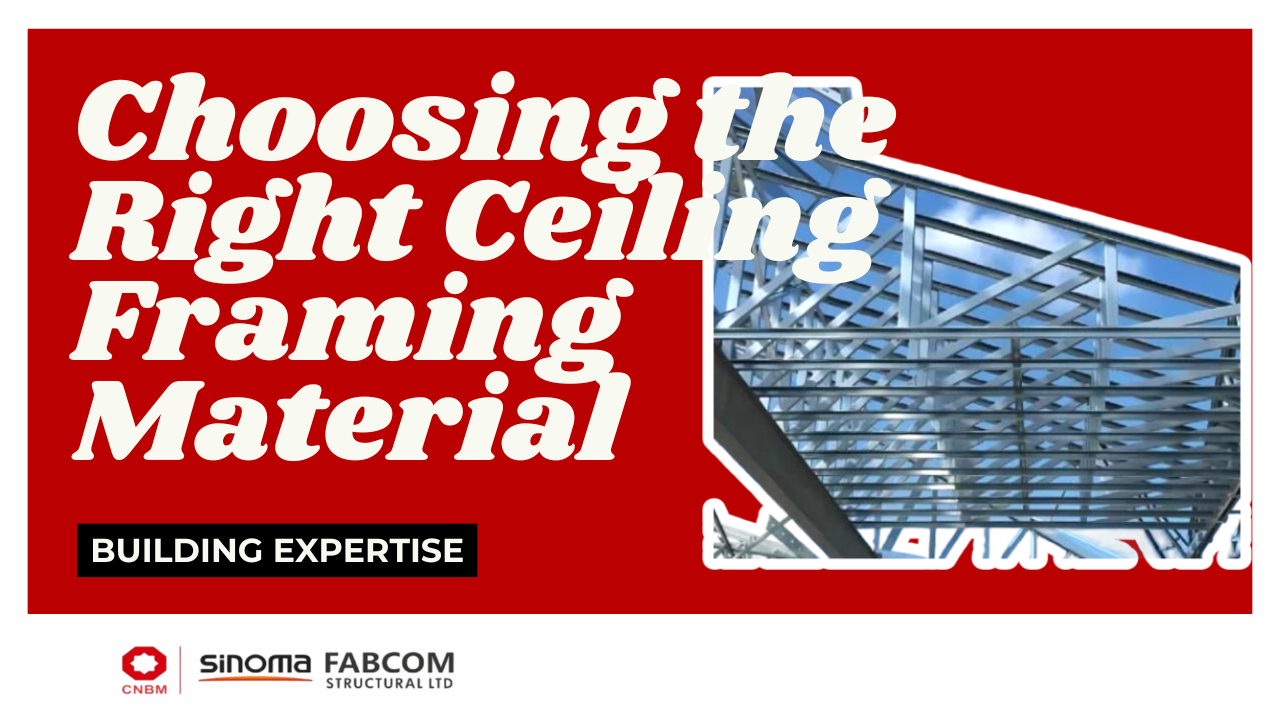
Choosing a ceiling framing material affects how long your ceiling lasts and how safe the space underneath remains over time.
Most people focus on what they can see, such as the POP design, the finishing and the lighting, which are actually the visible part of the ceiling that gets attention, yet the structure above it is ignored even thought it carries the weight every day.
This blog post explains how to choose the right ceiling framing material based on how buildings behave in Nigeria. Heat, moisture, termites, workmanship, and long-term use all affect how ceiling systems perform.

Why ceiling framing decisions matter more than you think
When a ceiling collapses, attention usually goes straight to what is visible. The POP design, the ceiling board, or the finishing is blamed first because that is what people can see and touch. In most cases, those elements are not the real problem. The issue starts from the structure above the ceiling, the part that is hidden after installation and rarely checked again.
- Why ceiling framing decisions matter more than you think
- Know what the ceiling will actually carry
- How The Conditions Affect The Ceiling Framing Material
- Consider termites and moisture, Like for real
- Think beyond purchase price
- Look for consistency and predictability
- Choose safety over familiarity
- Wood vs Light Steel Keel, What you Need to Know
- Frequently Asked Questions About Ceiling Framing Materials
That hidden structure is the ceiling framing. It carries weight every day, not just the weight of the boards, but also lighting fittings, fans, and any additional load introduced over time. As the building is used, that framing is exposed to heat from the roof, moisture from leaks or humidity, and gradual movement within the structure. These conditions do not cause immediate failure, but they create slow changes in the material. The framing can begin to bend, lose strength, or shift slightly out of alignment without any visible warning from below.
Because this process happens out of sight, it is often ignored until visible signs appear. Sagging sections, cracks, or unusual sounds are usually treated as surface problems, but at that point, the structural strength of the framing has already reduced. What looks like a minor ceiling issue is often the final stage of a problem that has been developing for years.
If the ceiling framing system cannot consistently handle these conditions, the ceiling will not remain stable over time. The failure may not happen immediately, but the risk continues to build as the material weakens. This is why the choice of ceiling framing material should be treated as a structural decision that affects long-term safety and performance, not just a finishing detail that is decided quickly during construction.
Know what the ceiling will actually carry
Before choosing any framing material, answer this honestly:
- Is this a plain ceiling board only?
- Will it carry POP designs or layered finishes?
- Are there ceiling fans?
- Will there be heavy chandeliers, recessed lighting, or speakers?
- Will technicians need to access the ceiling later for wiring or repairs?
Every extra feature will later increase the weight and add to the structural stress. Many ceiling failures happen because framing was chosen for a basic ceiling, then later loaded with a chandelier, a speaker, and a fan.
If the load is more than what was planed for, the framing will get weaker thereby becoming a safety risk, therefore if the ceiling will carry anything beyond plain boards, the framing system must be well thought and calculated.
How The Conditions Affect The Ceiling Framing Material
Building conditions in Nigeria are not neutral. The environment constantly puts pressure on materials, and over time, that pressure exposes weak choices.
Humidity stays high for long periods, especially during the rainy season. Roof spaces trap heat during the day and hold moisture at night. In many buildings, ventilation is not properly designed, so that heat and moisture have nowhere to go. Small roof leaks also go unnoticed for long stretches, allowing water to gradually enter the ceiling space rather than all at once. None of these conditions seems serious in isolation, but together, they create an environment where materials are tested every day.
Wood does not remain unchanged under these conditions. It absorbs moisture from the air and from any leak that reaches it. As that moisture builds up, the material begins to lose stability. It can swell, bend, or weaken internally. Even treated wood follows the same pattern over time. Treatment slows down the process, but it does not stop moisture from entering the material completely. Once that process starts, the reduction in strength happens gradually and often without any visible warning.
Termites add another layer of risk that is harder to control. They do not damage wood from the outside where it can be seen easily. They work from within, reducing the strength of the material slowly. By the time there are visible signs, the structural integrity of the framing has already been affected. What looks solid on the surface may no longer be able to carry the same load.
When a ceiling framing material reacts this way to moisture and termites, it introduces uncertainty into the building. The performance of the ceiling is no longer predictable because the strength of the framing is changing over time.
Light steel keel systems respond differently under the same conditions. They do not absorb moisture, so their shape and strength remain stable even in humid environments. They do not rot, and termites do not affect them. What is installed maintains its structural properties over time without depending on environmental conditions or chemical treatment.
This difference is not about preference. It is about how materials behave when exposed to real conditions over years of use.
Consider termites and moisture, Like for real
Nigeria’s climate is not that friendly to wood due to the high humidity, seasonal rainfall, roof leaks, and poor ventilation create ideal conditions for rot and termite activity. Even treated wood will not last forever cause the treatment will wears off and moisture will finds its way in and termites are very patient insect.
All this is not something you can see all the time as those damage do happens out of sight. From below, the ceiling may look fine while the framing above is slowly being eaten or weakened.
Ask yourself this uncomfortable question:
If this framing material gets wet or attacked, how much strength does it lose?
If the answer is “a lot,” then failure is not a question of if, only when.
Light steel keel systems do not absorb moisture, do not rot, and do not attract termites. Their strength remains consistent even in humid conditions.
Think beyond purchase price
Choosing cheap and low-quality ceiling framing material will increase cost as times goes on.
Wood framing often looks cheaper upfront, but hidden costs show up over time:
- Ceiling repairs
- POP replacement
- Tenant complaints
- Emergency fixes
- Safety risks and liability
Many homeowners only calculate the material cost, not the lifecycle cost.
A better question to ask is:
How long will this ceiling framing last without repair or reinforcement?
If the answer is uncertain, the initial savings are misleading.
Steel framing, also known as Light Steel Keel, typically costs more at the start but requires far less maintenance over time. In many cases, they end up being the cheaper option over the building’s lifespan.

Look for consistency and predictability
One of the biggest problems with wood as a choice of ceiling framing is inconsistency.
Wood varies in:
- Strength
- Moisture content
- Straightness
- Density
Two pieces of wood bought on the same day can behave very differently over time. This leads to uneven ceilings, sagging sections, and weak points.
Good framing systems should be:
- Uniform in strength
- Straight
- Factory-measured, not guessed
- Installed with clear spacing standards
Light steel keel systems are manufactured to specification. What you install today behaves the same way tomorrow and five years from now.
That predictability is critical for ceiling safety.
Choose safety over familiarity
Wood feels familiar but that doesn’t make it safe, thought many builders continue using wood because “that is what we have always used.” But building standards evolve because materials fail under real conditions.
Buildings, nowadays, especially multi-unit homes, offices, and commercial spaces require materials that can be predicted.
That is why light steel keel is now preferred for:
- Ceilings
- Wall partitions
- Drywall systems
It reduces installation errors and minimizes the common failure risks associated with traditional ceiling framing materials
Wood vs Light Steel Keel, What you Need to Know
Wood framing:
- Vulnerable to termites
- Weakens with moisture
- Strength varies from piece to piece
- Lifespan depends heavily on treatment quality and environment
Light steel keel framing:
- Termite-resistant
- Moisture-stable
- Uniform strength
- Designed for long-term structural consistency
Frequently Asked Questions About Ceiling Framing Materials
Is wood ceiling framing completely unsafe in Nigeria?
Wood framing is not automatically unsafe, but it is high-risk in Nigerian building conditions. Heat, humidity, termites, and inconsistent wood quality reduce its reliability over time. Even treated wood can lose protection, especially in buildings with roof leaks or poor ventilation. The real issue is not day-one strength; it is how the material behaves after five to ten years. Many ceiling collapses happen long after handover, when the original treatment has worn off and inspection has stopped.
Can Light Steel Keel carry POP ceilings and ceiling fans?
Yes, when properly specified and installed. Light steel keel systems are designed to carry predictable loads, including POP ceilings, lighting fixtures, and ceiling fans. Unlike wood, steel does not weaken with moisture or insects, so its load-carrying capacity remains stable over time. The key is proper spacing, correct gauge selection, and adherence to installation standards.
Why do ceilings look fine for years before collapsing?
Because ceiling failure is gradual, not sudden. Framing materials weaken quietly due to termites, moisture, nail loosening, or overload. The ceiling board hides this damage. By the time sagging or cracking appears, the framing has already lost significant strength. Collapse is usually the final stage of a long, ignored process.
Is light steel keel more expensive than wood?
At purchase point, light steel keel often costs more than wood. However, when maintenance, repairs, and replacement risks are considered, steel is usually cheaper over the building’s lifespan. Wood framing may require repairs, reinforcement, or full ceiling replacement years later. Steel framing reduces those long-term costs and safety risks.
Can light steel keel be used in residential homes, or is it only for commercial buildings?
Light steel keel is suitable for residential, commercial, and institutional buildings. In fact, it is increasingly preferred in homes because homeowners want ceilings that last without hidden problems. It is especially recommended for multi-bedroom homes, apartments, offices, and any space with POP ceilings or heavy fittings.
What causes most ceiling framing failures during installation?
Common installation problems include incorrect spacing, wrong fasteners, cutting corners to save time, and ignoring load calculations. With wood framing, installers often rely on judgment rather than measurement. Steel keel systems reduce this risk because they are installed using defined spacing and standardized components.
How do I know which framing material is right for my project?
Start by assessing ceiling load, building type, exposure to moisture, and long-term usage. If the ceiling is basic and temporary, wood may survive. If the ceiling is permanent, decorative, or safety-critical, light steel keel is the safer choice.

For more information, use the form below or send us a message on WhatsApp!
Your message has been sent
Our team will contact you shortly within 24 hours with your quote and more information about your roofing needs. Thank you
