
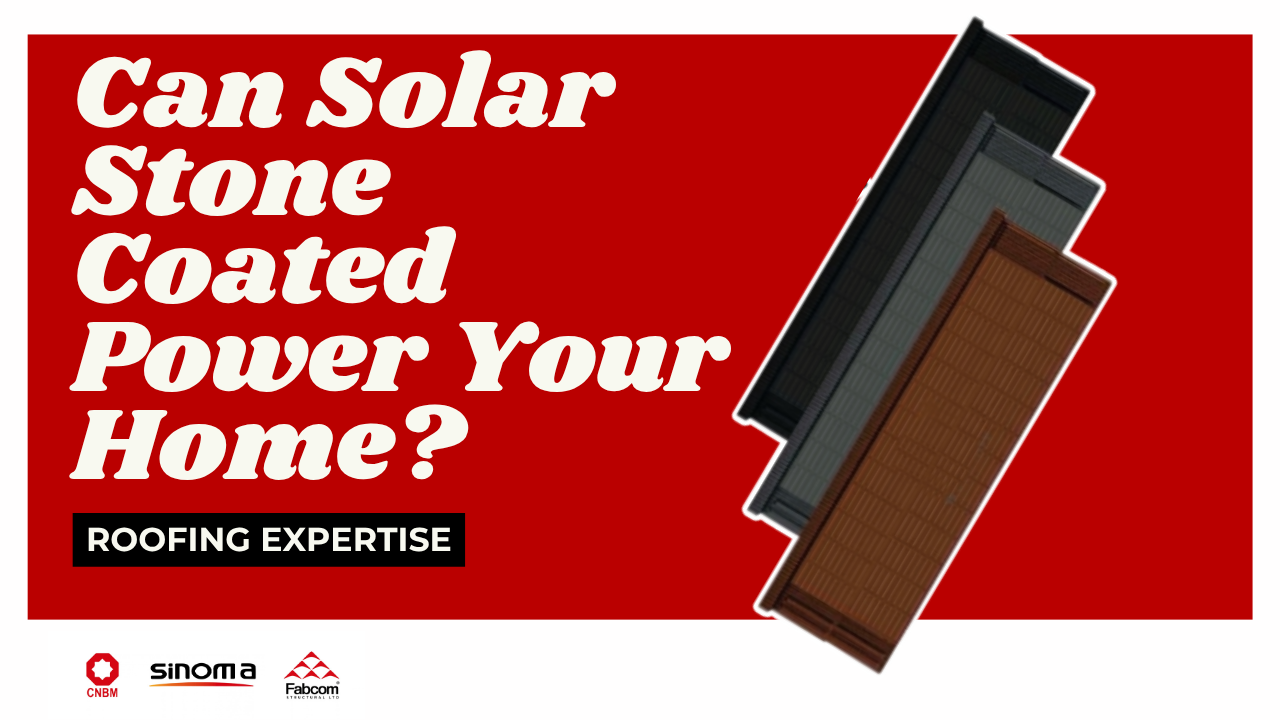
If you are building a house in Nigeria and have started looking at stone coated roofing, we have a new product for you, which is the solar stone coated roofing and wondered whether it is a genuine source of household electricity or simply a roofing product with a solar feature.
That is a reasonable question. A roof can look like a normal stone-coated roof while also containing solar-generating tiles, but the appearance does not tell you how much electricity the system can produce. If you are considering solar roofing for your home, the important questions are how much power the solar roof can generate, which appliances it can support, whether it can work during the rainy season, and how it compares with conventional solar panels.

You will want to know how solar stone coated roofing in Nigeria works in practical terms. It also explains what an 80W solar roofing tile means, how multiple tiles work together, why the battery and inverter matter, and why the right system for one house may not be the right system for another.
- What is Solar Stone Coated Roofing?
- Why the Battery Matters Just as Much as the Solar Roof
- What Happens During the Rainy Season?
- Does Rain Damage Solar Roofing?
- What about Heat in Nigeria?
- Is Solar Stone-Coated Roofing Better Than Regular Solar Panels?
- What Makes Solar Stone-Coated Roofing Attractive for a New House?
- Can Solar Roofing Power an Entire Nigerian Home?
- Solar Roofing Is About the Complete System
- So, Can Stone-Coated Roofing Really Power Your Home?
What is Solar Stone Coated Roofing?
Solar stone coated roofing combines the appearance and function of a stone-coated roof with solar-generating technology. It is also commonly described as a solar shingle or solar roof tile.
A conventional rooftop solar system normally has two separate components. The building has its roofing material, and solar panels are installed above the roof using a mounting system.
With an integrated solar roofing system, the solar-generating component forms part of the roof itself.
That changes the way the roof is designed, but it does not change the basic principle of solar electricity. The solar component receives sunlight and converts that energy into direct-current electricity. An inverter then converts the electricity into alternating current that household appliances can use. If batteries are included, some of the solar energy can be stored and used later when the sun is no longer available. The inverter is a key part of a photovoltaic system because most household appliances use AC electricity, while batteries provide storage for later use.
For Fabcom Structural solar stone-coated roofing product, each solar stone coated roofing tile is rated at 80W.
An 80W rating does not mean one tile will continuously supply 80W to your home throughout the day. It is the nominal power rating of that tile under specified test conditions. Actual solar generation varies with sunlight, shading, temperature, roof orientation, dirt, wiring and other system losses. The U.S. Department of Energy notes that real-world solar output is affected by factors including heat, dirt, shade, time of day and the amount of sunlight reaching the module.
So when someone asks, “Can solar stone-coated roofing power my home?”, the answer depends on the size and design of the complete solar system, not simply the fact that the roof contains solar tiles.
How Much Electricity can Solar Stone Coated Roofing Generate?
The easiest place to start is the rated capacity of the solar roof tiles, and one solar stone coated roofing tile is rated at 80W:
| Number of solar tiles | Nominal solar capacity |
|---|---|
| 5 tiles | 400W |
| 10 tiles | 800W |
| 20 tiles | 1,600W |
| 25 tiles | 2,000W |
| 50 tiles | 4,000W |
| 75 tiles | 6,000W |
| 100 tiles | 8,000W |
These are nominal capacities, not guaranteed daily energy production for example, 20 tiles would give you a nominal capacity of 1.6kW. That does not mean the system will produce 1.6kW every hour from morning until evening. Solar output changes throughout the day.
The roof may receive strong sunlight around midday and much less in the early morning or late afternoon. Clouds can reduce output. Shade from a nearby building or tree can reduce output. Dirt on the solar surface can also affect the amount of sunlight reaching the cells.
This is why solar system sizing is normally based on energy consumption and expected solar resource, rather than simply multiplying the module rating by some hours. Solar industry analysis distinguishes between the nameplate rating of a PV system and the energy it actually produces over time.
Whenever you are talking to your installer, this is what you should have at the back of your mind.
“How much electricity does my household need, and how much of that requirement can the proposed solar roof realistically provide?”
Can Solar Stone Coated Roofing Power Household Appliances?
Yes, the solar roof tiles can be used to power household appliances, provided the complete system has been correctly designed for the loads you want to run, since the appliances do not run directly from the roofing tiles.
The electricity produced by the solar-generating roof section passes through the electrical system, which can include an inverter and battery storage.
The inverter converts the DC electricity produced by the solar system into AC electricity for household use. The battery stores electricity so that it can be used when solar generation is lower or when the sun is no longer available.
This means the solar roof tiles can form part of a system that supports appliances such as:
- LED lighting
- televisions
- fans
- refrigerators
- routers and other small electronics
- selected pumps
- computers and office equipment
- other household appliances, depending on the system size
Larger appliances require more careful planning, and air conditioners, electric water heaters, large pumping systems, electric cookers and other high-load appliances can consume substantial amounts of power. If the homeowner expects the solar system to run these loads, the system needs to be sized around their actual consumption rather than around an attractive number of solar tiles.
A house with ten 80W solar tiles is not equivalent to a house with fifty 80W solar tiles. The nominal capacity is five times larger in the second example, and the rest of the electrical system also needs to be appropriately sized.
Why the Battery Matters Just as Much as the Solar Roof
A solar roof tiles produces electricity when sunlight is available. Your household does not necessarily use electricity at exactly the same time.
This is particularly obvious in the evening.
The sun is no longer producing solar energy after sunset, but that may be when the family is using lights, televisions, fans, refrigerators and other appliances.
This is where battery storage becomes important.
A battery can store part of the energy produced during the day and make that stored energy available later, the batteries allow solar energy generated during periods of high solar production to be used at other times, including after sunset or when solar production is reduced by weather.
This creates two separate questions when evaluating a solar roofing system:
- How much solar electricity can the roof generate?
- How much electricity can the battery store and deliver when the roof is not producing enough?
A system can have sizeable solar roof tiles and still have limited evening backup if the battery capacity is small.
The reverse can also create a problem. A large battery does not create electricity. It stores electricity that has been generated elsewhere, so the solar generation capacity and battery capacity have to make sense together.
Solar Capacity and Battery Capacity Are Not the Same Thing
This distinction tends to confuse people when comparing solar quotations; you know that the solar capacity is normally expressed in watts or kilowatts. It describes the rate at which the solar system can generate electricity under specified conditions.
Battery capacity is normally expressed in watt-hours or kilowatt-hours. It describes how much energy the battery can store.
For example, a proposed system might have a 4kW solar array and a 5kWh battery. Those numbers describe different things, while the 4kW figure relates to the solar generation capacity. The 5kWh figure relates to the battery’s stored energy capacity.
You therefore cannot decide whether a solar system is sufficient by looking at the solar tile quantity alone.
When reviewing a quotation, ask for the solar capacity, inverter capacity and battery capacity separately.
What Can a 1.6kw Solar Roof Realistically Do?
Consider a simple example.
Suppose a building has 20 solar stone-coated roofing tiles rated at 80W each. The nominal solar capacity is:
20 × 80W = 1,600W, or 1.6kW.
That gives you a useful starting point for discussing the system.
It does not mean you can simply assume the roof will deliver 1.6kW for every hour of daylight. Actual production depends on the site and operating conditions.
If the household wants the system to support lighting, fans, a television, a refrigerator and small electronics, the installer can assess whether a system of that size is appropriate.
If the household also wants several air conditioners, a large electric water heater and other high-demand appliances, the calculation changes.
The right system therefore comes from the load profile of the building, not from the roof’s appearance.
What Happens During the Rainy Season?
Solar roofing can still generate electricity during the rainy season, but solar output can fall when clouds, rain and reduced sunlight limit the amount of solar radiation reaching the solar cells.
Solar photovoltaic systems do not require only perfectly clear skies to operate. They can use both direct and diffuse sunlight, which means they can continue generating electricity under cloudy conditions, although output can be lower. NREL explains that PV systems can operate on cloudy days because they use diffuse radiation, clouds, rain, dust, haze and shadows among the factors that can affect solar production.
So the answer is not that solar roofing stops working whenever it rains.
The more accurate explanation is that the amount of electricity generated can change with the weather.
This is why battery storage is useful. During periods when the solar roof is producing more electricity than the home is using, the excess can be stored for later use. During periods of lower solar generation, stored energy can help support the household.
For a Nigerian homeowner, this is a more useful way to think about solar roofing than asking whether the roof works in rain at all.
The system works as an energy system across changing conditions. It does not promise the same solar output every hour of every day.
Does Rain Damage Solar Roofing?
Rain itself does not mean that a properly designed solar PV system cannot operate, as the wider installation still needs to be designed for the building’s weather conditions. Electrical equipment such as inverters, switches and other components should be appropriately protected, particularly where equipment could be exposed to heavy or wind-driven rain.
For the roofing side, the solar product also needs to be installed according to its manufacturer’s requirements so that the roof continues to perform its normal weatherproofing function.
This is why solar stone coated roofing should be treated as a roofing project and an electrical project at the same time.
What about Heat in Nigeria?
The climate here makes temperature an important consideration when discussing solar generation, since the solar modules are tested under standard conditions, but real-world conditions can be hotter than those laboratory conditions. The PV performance is affected by temperature as well as the intensity and angle of incoming sunlight.
This does not mean that a hot Nigerian day makes solar roofing useless. It means the rated output should not be interpreted as a permanent operating output under every condition.
The actual performance of a system depends on the product’s technology, installation, ventilation, roof design, sunlight and other conditions.
This is another reason to look at expected system performance rather than relying only on the wattage printed on the product specification.
Is Solar Stone-Coated Roofing Better Than Regular Solar Panels?
There is no universal answer, but the better option depends on what you are trying to achieve with the building.
Conventional solar panels have an established advantage in flexibility. They can be installed on suitable existing roofs, and the solar array can be designed independently from the main roofing material.
Solar stone coated roofing has a different proposition. The solar-generating component forms part of the roof design, which can be attractive to someone building a new home or replacing the roof and wanting solar generation incorporated into the architecture.
A simple comparison looks like this:
| Consideration | Solar stone-coated roofing | Conventional solar panels |
|---|---|---|
| Roof appearance | Solar generation is incorporated into the roof design | Panels sit above the roofing |
| New construction | Can be planned as part of the roof | Can also be planned during construction |
| Existing roof | Suitability depends on the specific roofing system | Can often be added to a suitable existing roof |
| Roof replacement | Can combine roofing and solar decisions | Roof and solar remain separate systems |
| Solar capacity | Depends on the number and rated output of solar tiles | Depends on panel quantity and panel rating |
| Battery | Can be integrated into the wider system | Can be integrated into the wider system |
| Maintenance | Roofing and solar maintenance need to be considered together | Panel and mounting system maintenance are separate from the roof |
| Roof aesthetics | Designed to form part of the roof | Visible panel array above the roof |
| Flexibility | Depends on the solar roofing product and roof layout | Broad range of panel sizes and mounting options |
If you already have a good roof that is not shingle roof and simply want to add a solar system, conventional solar panels may be the more straightforward route.
If you are constructing a new building or replacing the roof and want solar system incorporated into the roof itself, solar stone coated roofing may be worth considering.

What Makes Solar Stone-Coated Roofing Attractive for a New House?
For a new house, the main advantage is that the solar stone coated roofing can be considered at the same time as the roof.
The roof shape, solar section, electrical equipment, cable routes and battery location can all be discussed before construction is completed, which can help avoid some of the compromises that occur when solar is added after the building has already been finished and also gives the homeowner more control over the appearance of the roof.
For someone who wants a shingle stone coated roof but also wants solar generation, solar stone coated roofing provides a way to consider both requirements within the same roof design.
However, the architectural benefit should not replace the technical assessment.
A roof section that looks ideal may have shading problems. A large roof does not automatically mean that every part of it is suitable for solar. The system still has to be sized around the household’s energy requirement.
Can Solar Roofing Power an Entire Nigerian Home?
It can form part of a system capable of powering a home, but there is no single answer for every house.
A small home with efficient appliances and a carefully designed solar and battery system has a different electricity requirement from a large home running several air conditioners, pumps, refrigeration equipment and other high-load appliances.
The question should therefore be framed around the home’s energy demand by listing the appliances you want solar to support and then consider how many hours each appliance operates.
For example:
| Appliance | What to assess |
|---|---|
| Refrigerator | Running load and daily operating pattern |
| Fan | Number of fans and hours used |
| Television | Wattage and hours used |
| Lighting | Number of lights and hours used |
| Air conditioner | Rated load and expected operating hours |
| Water pump | Motor size and operating schedule |
| Computer | Power requirement and working hours |
| Electric cooker | High load and duration of use |
The installer can then use this information to determine an appropriate system configuration, which is a more reliable approach than saying, “I have a four-bedroom house, so I need X number of solar tiles.” Yes, the size of your house and the number of rooms you have do not tell you the household’s electricity consumption.
What Happens If the Solar Roof Is Too Small?
Suppose a customer wants solar power for several high-demand appliances, but the roof design does not have enough suitable area for the required solar capacity, the system can be reconsidered.
The solar roof tiles section could be increased if the roof allows it. Conventional solar panels could potentially supplement the system where appropriate. The battery and load management strategy could be reviewed. Some appliances could be prioritised for solar power while others remain connected to another power source.
The important point is to identify this before installation, as the solar roofs should be designed around the actual electricity requirement instead of selecting the solar tile quantity first.
Does a larger roof mean more solar power?
Not necessarily, while a large roof provides more physical space, usable solar area depends on the roof layout, orientation, slope, shading and the product’s installation requirements.
A roof can also contain sections that are unsuitable because of shade, roof geometry or other building features.
You need to remember that the roof size, shape, slope, orientation and shading are factors that affect rooftop solar potential.
This is why an installer should assess the actual roof before giving a final system recommendation.
What should you ask a solar roofing supplier?
If you are already considering solar stone coated roofing, ask the supplier questions that connect the roofing product to the complete energy system.
Start with these:
- What is the rated output of each solar roofing tile?
- How many tiles are being proposed for my roof?
- What is the total nominal solar capacity?
- What appliances is the proposed system designed to support?
- What inverter capacity is required?
- How much battery storage is included?
- How much of my roof will be solar and how much will use conventional stone-coated roofing?
- Has the roof been assessed for sunlight and shading?
- How will the solar roofing connect to the rest of the electrical system?
- What happens to performance during periods of heavy rain or cloudy weather?
- What maintenance does the solar roofing require?
- What are the warranty terms for the roofing, solar component, inverter and battery?
These questions help you move from “I like the idea of solar roofing” to a realistic understanding of what the system can do.
Solar Roofing Is About the Complete System
A solar stone coated roofing tile is one part of a larger energy system, as the roof generates electricity. The inverter converts it into usable AC power. The battery can store energy for later use. The home’s electrical loads determine how much power is required. Weather, shading, temperature and system losses affect how much energy the solar roof produces.
That is why the 80W rating of a solar roofing tile is useful for understanding the system, but it is not a promise that the tile will supply 80W continuously.
For example, 50 Fabcom structural solar stone coated roof tiles would have a nominal capacity of 4kW. Whether that system is appropriate for a particular home depends on the home’s electricity consumption, roof conditions, expected solar resource, inverter, battery and wider system design.
The same principle applies to rainy weather. Solar roofing does not stop being useful because clouds appear, but reduced sunlight can reduce electricity generation. Batteries and an appropriately designed energy system help manage that variation.
So, Can Stone-Coated Roofing Really Power Your Home?
Yes, solar stone coated roofing can generate electricity for household use. The important question is how much of your home’s electricity requirements it can support.
A solar roof tile with a small number of 80W tiles will have a different capability from one with a larger solar area. A home with modest electricity consumption will have different requirements from a large property with several high-load appliances. A roof with good sunlight exposure will also perform differently from one affected by substantial shade.
Solar stone-coated roofing should therefore be evaluated as a complete system rather than as a roofing material with a wattage printed on the specification sheet.
If you are considering solar stone coated roofing in Nigeria, start by establishing your household’s electricity requirement. Then assess the suitable roof area, sunlight exposure, number of solar tiles, inverter capacity and battery storage. Once those figures are clear, you can decide whether solar roofing can meet the role you want it to play in the building.
For a new house, this conversation should happen while the roof is still being designed. For an existing building, begin with an assessment of the roof and the property’s solar potential.
If you are considering Fabcom Structural solar stone coated roofing, you can also review the dedicated solar roofing product information and then discuss your roof design, intended appliances and preferred system configuration with the Fabcom Structural sales team. That gives you a more useful starting point than choosing a solar roof tile quantity without first understanding what the building needs.
Your message has been sent
Our team will contact you shortly within 24 hours with your quote and more information about your roofing needs. Thank you
