
When it comes to stone coated roofing tiles in Nigeria, most homeowners and even some distributors look at only one thing first: the price.
But here is the truth many people don’t know:
The real thing that determines the strength, lifespan, and price of any stone coated roofing tile is the coil gauge.
Not the colour.
Not the design.
Not the name of the profile.
It is the coil, the metal thickness that forms the foundation of every stone coated roof.
At Fabcom Structural Ltd., coil gauge is one of the first things we explain to our customers, because once you understand it, you will never be confused by roofing prices again.
This post will breaks down the coil gauge used in Stone Coated Roof, so you can choose the best option for your home or for your customers, confidently and based on facts.
- What Is The Stone Coated Roofing Coil Gauge?
- Why Does Coil Gauge Matter So Much?
- Why We Offers Different Coil Gauges (0.20mm – 0.40mm)
- What Each Gauge Means and Who It Is For
- The Mistake Many Buyers Make
- How Fabcom Structural Protects
- Why Coil Gauge Should Be the First Thing You Check (Not the Last)
- How to Choose the Best Gauge for Your Home
- Why Our Approach Makes Roofing Safer for You
- How to Measure Coil Gauge Yourself (If You Don’t Fully Trust the Supplier)
- Why We Encourages Customers to Measure Our Coil Gauge
- Coil Gauge Is Not Just a Number
What Is The Stone Coated Roofing Coil Gauge?
Every roofing material, whether stone coated or long span, starts from one thing: a coil and the coil is like the “raw skin” of the roofing sheet. The thickness of this coil is what we call the gauge.
- A lower number = thicker coil
- A higher number = thinner coil
So:
- 0.20mm → Thinnest in the stone-coated range
- 0.22mm → Slightly stronger
- 0.24mm → Common mid-strength option
- 0.26mm → Stronger and more durable
- 0.40mm → Thickest, strongest and heavy
Different gauges come with different prices because more thickness means more steel, and more steel means more strength and more cost.
Why Does Coil Gauge Matter So Much?
Because coil thickness determines:
- Strength against wind: Thicker coil can resist bending and lifting better during storms.
- Weight on the roof: Thicker coil carries more weight. This is good for durability, but you need proper installation.
- Noise control: A stronger coil reduces vibration and makes the roof quieter.
- Lifespan: The thicker the base, the longer the roof remains stable and resistant to stress.
- Price: This is exactly why coil gauge is directly tied to product positioning and budget.
Why We Offers Different Coil Gauges (0.20mm – 0.40mm)
Nigeria has different types of homeowners and different roofing budgets.
Some are building rental houses.
Some are building family homes.
Some are building luxury houses.
This is why we has four different roofing brands, each positioned for different needs:
- ZumaStone – Budget-friendly (0.20mm & 0.22mm)
- Fabcom – Mid-range (0.24mm & 0.26mm)
- SolarStone – Stone coated solar roofing tiles (Solar Shingle)
Each coil gauge we use is intentional, so it can matched to the brand purpose and ensured they to fit a customer’s budget without compromising safety as some customers need an affordable option that still meets standard roofing quality, that is where ZumaStone comes in.
Some customers want stronger, long-term investment roofing, that is where Fabcom and ApexStone fit in and that is brand product positioning, and it is how we make roofing accessible to every Nigerian.
What Each Gauge Means and Who It Is For
Let us keep this very practical.
1. 0.20mm Coil Gauge (Budget-friendly choice)
Best for:
- Rental buildings
- Low-cost housing
- Shops
- Budget-conscious homeowners
Pros:
- Most affordable
- Light on the roof
- Good performance for its class
What to expect:
If you want something strong enough but don’t want to overstretch your budget, this gauge is your entry point.
2. 0.22mm Coil Gauge (Better strength, still affordable)
Best for:
- Family houses on budget
- School buildings
- Churches
- Developers building multiple units
Pros:
- More strength than 0.20mm
- Better wind resistance
- Still affordable
What to expect:
This is the “sweet spot” for customers who want more confidence without much extra cost.
3. 0.24mm Coil Gauge (Mid-range durability)
Best for:
- Personal homes
- Duplexes
- Homeowners who want good price + durability balance
Pros:
- Noticeably stronger than 0.22mm
- Longer lifespan
- Higher resistance to bending
What to expect:
This is the coil gauge commonly used in the Fabcom brand, a strong option with great value.
4. 0.26mm Coil Gauge (Strongest in mid-range)
Best for:
- Family homes
- Homes in windy areas
- Customers looking for long-lasting roofing
Pros:
- High strength
- Better long-term stability
- Good for areas with rough weather
What to expect:
A strong, reliable gauge for customers who want durability without moving into premium pricing.
4. 0.40mm (Heavy and Strongest)
Best for:
- Mansion homes
- Homes in windy areas
- Customers looking for long-lasting roofing
- Developers targeting premium clients.
- Best for luxury homes and customers prioritizing strength above everything else.
Pros:
- High strength
- Better long-term stability
- Good for areas with rough weather (rain and storm)
What to expect:
A strong, reliable gauge for customers who want durability and strength in the premium pricing.

The Mistake Many Buyers Make
This is the fastest way to get deceived.
Two roofing sheets may look the same and even have the same colour, but their coil gauges may be different.
That is why prices can differ by hundred of naira.
You must always ask:
“What coil gauge did you use?”
If a seller avoids that question or keeps changing the topic, that is your warning sign.
Another thing you can do is go with a caliper and measure the coil sheet, not just the finished roofing material. Most of the misinformation in the market comes from vendors quoting a thickness that doesn’t match what they are selling. The most accurate way to confirm any roofing product’s thickness is to measure the raw coil before it goes into production.
This is why we always encourage customers, contractors, and project managers to visit any of our factories and measure our coils themselves. We give full access because we want buyers to know exactly what they are paying for, no guesswork, no assumptions. When you measure directly from the coil, you see the true gauge, and you can confidently compare quality across brands.
How Fabcom Structural Protects
- We make sure you understand the technical details, expected performance, and long-term value behind your purchase. When customers are informed, they make better decisions and get better roofs.
- We clearly state the coil gauge for every product, no vague claims, no “approximate” thickness. Every tile, sheet, or profile is backed by its actual coil specification measured before production.
- We match each gauge to the correct brand category, whether it is ApexStone, Fabcom, or ZumaStone, each brand is aligned with the appropriate thickness and performance level so customers can compare options properly.
- We do not hide or inflate specifications, our product sheets, invoices, and coil labels show exactly what you are buying. What you see on paper is what you receive on-site.
- We guide you to choose based on strength, budget, and project needs, our team explains the performance difference between gauges so you can select what works for your building, not what a vendor wants to push.
Why Coil Gauge Should Be the First Thing You Check (Not the Last)
When buying roofing tiles in Nigeria, many people check colour first.
Some check the name of the profile:
Milano, Bond, Classic, Shingle.
But if you check the design without checking the coil gauge, you might buy something weaker than you intended.
Coil gauge is the real “engine” of the roofing sheet.
Design is just the “body paint.”
A beautiful roof with weak coil will fail faster.
A simple-looking roof with strong coil will last longer.
How to Choose the Best Gauge for Your Home
Here is a quick guide you can use:
If your budget is tight
Choose: 0.20mm or 0.22mm
Brand: ZumaStone
If you want durability at a fair price
Choose: 0.24mm or 0.26mm
Brand: Fabcom
If you want premium performance
Choose: 0.40mm
Brand: ApexStone
If you want energy + roofing together
Choose: Solar Stone Coated roofing tiles
(Stone coated roofing tiles with solar panel that supply electricity)
Why Our Approach Makes Roofing Safer for You
Because we manufacture in Nigeria under Sinoma (a global engineering group), we have strict quality control.
We don’t reduce coil thickness just to make “cheap roofing” that fails after a few years.
Instead, we:
- Use the right coil gauge for the right brand
- Display our specifications clearly
- Allow customers to choose confidently
- Provide consistent product positioning
This protects your investment and helps you avoid the stress and cost of re-roofing.
How to Measure Coil Gauge Yourself (If You Don’t Fully Trust the Supplier)
Many customers tell us the same thing:
“Some suppliers say 0.24mm but when you measure it, it is not even close.”
It happens.
And this is why you should know how to check the coil thickness by yourself right on-site before you pay.
Here are the three easiest ways to confirm the real coil gauge of any roofing sheet:
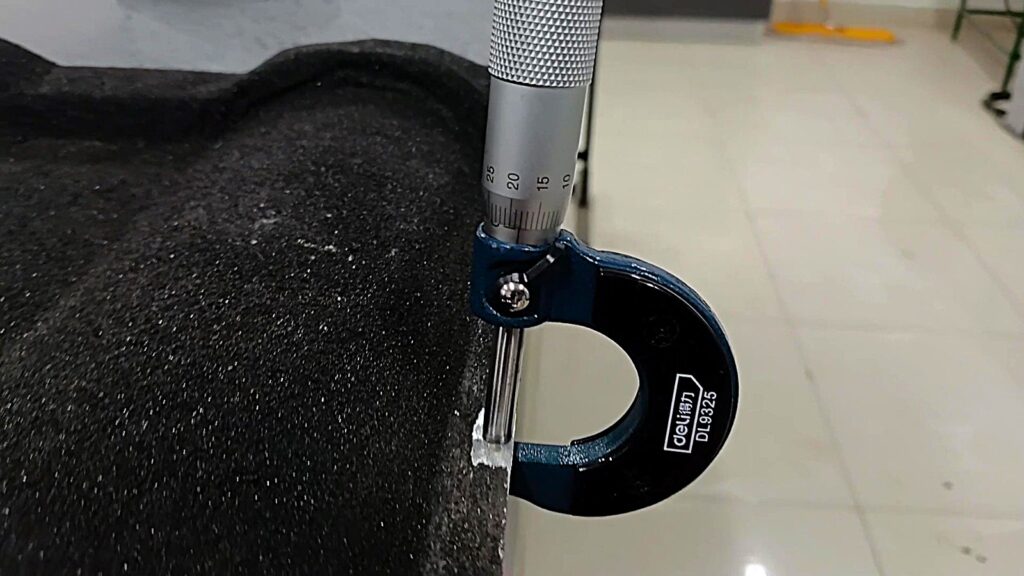
1. Use a Micrometer or Digital Vernier Caliper (Most Accurate Method)
If you want the truth in seconds, this is the best tool.
How to do it:
- Ask the supplier for a sample tile or cut a small edge.
- Place the micrometer jaws on the metal part (not the stone coating section).
- Take the reading.
- Compare the number with what they claimed.
Important:
Stone coated roofing tiles have coatings (glue, sand, paint), so your reading may be a bit higher than the coil itself.
But you can estimate:
- Stone coat layers usually add 0.05mm–0.07mm.
So if the supplier claims 0.24mm and your reading shows 0.32mm, that is normal after adding coating thickness.
What should worry you is when a supplier claims 0.24mm, but your reading shows something like 0.26mm total thickness, that means the coil used is lower than promised.
2. Scratch Test (Quick but Less Precise)
This is a simple field test.
How to do it:
- Use a blade to scrape a small spot on the roofing sheet.
- Remove the stone coating until you reach the metal.
- Measure the metal thickness alone with a caliper.
This gives you a closer estimate of the real coil gauge.
3. Compare Weight and Flexibility (For People Without Tools)
If you don’t have a tool, you can still detect a lie through simple observation.
Here is how:
A. Weight Test
Thicker gauges are naturally heavier.
0.20mm will feel noticeably lighter than 0.26mm.
Hold a tile in each hand (from different suppliers) the difference will blown your mind away.
B. Flex Test
Bend the edge gently.
- 0.20mm bends easily
- 0.22mm bends a bit but holds shape
- 0.24mm is firmer
- 0.26mm is noticeably stiffer
- 0.40mm hardly bends at all
If a supplier is calling something “0.26mm” but you can bend it like cardboard, that is your sign.
Why We Encourages Customers to Measure Our Coil Gauge
Unlike many suppliers, Fabcom Structural is not afraid of measurement tools.
We welcome it.
We manufacture under strict Sinoma/CNBM standards, so our coil gauge is consistent:
- ZumaStone → 0.20mm / 0.22mm
- Fabcom → 0.24mm / 0.26mm
- ApexStone → 0.35mm / 0.40mm
- SolarStone → Specialized solar-integrated tiles
What we tell you is exactly what you get.
And that is why we always advise customers:
“Bring your micrometer. Bring your engineer. Bring your eyes.”
You deserve transparency.
And a roof is too important to guess.
Coil Gauge Is Not Just a Number
If you remember nothing else from this article, remember this:
The coil gauge is the true measure of roofing quality.
When choosing roofing in Nigeria, always check:
- What gauge am I paying for?
- Does this gauge match the price?
- Does this gauge match my purpose?
- Is the brand transparent?
At Fabcom Structural, we make this easy because every brand has its own coil gauge range — so you know exactly what you are getting.
Whether you are a homeowner, distributor, or contractor, understanding gauge gives you more confidence, better choices, and better results.
If you need help deciding the best gauge for your building, our team can guide you based on:
- Your budget
- Your location
- Your building type
- Your long-term plan
For inquiries, Send us a message via WhatsApp or place your order via the form below
Your message has been sent
Our team will contact you shortly within 24 hours with your quote and more information about your roofing needs. Thank you
